
Encryption format
All cryptography runs in the browser with WebCrypto. The implementation is web/src/lib/crypto.ts.
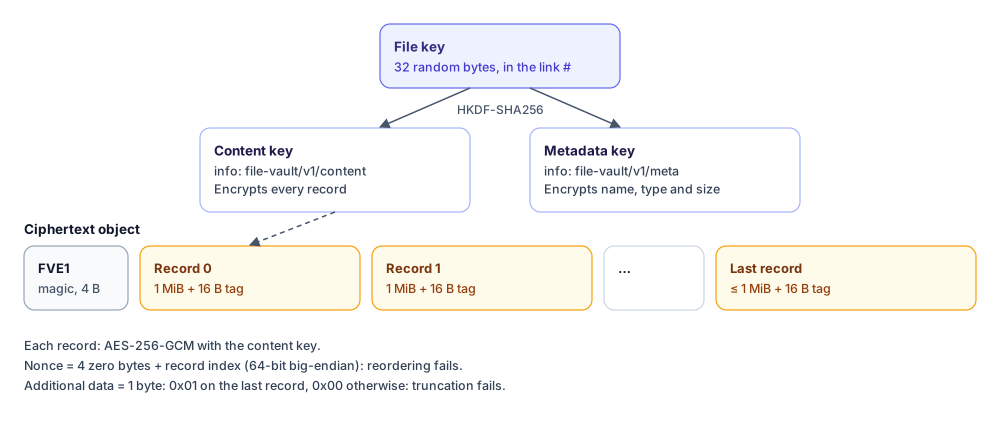
- A fresh 256-bit key is generated for every share with
crypto.getRandomValues. - It is encoded as 43 characters of unpadded base64url and placed in the link fragment after the token:
#<token>.<key>. - HKDF-SHA256 derives two AES-256-GCM keys from it, with a 32-byte zero salt:
| Info string | Key used for |
|---|---|
file-vault/v1/content |
File content |
file-vault/v1/meta |
Metadata |
Content: format FVE1
Section titled “Content: format FVE1”"FVE1" | record_0 | record_1 | … | record_n-1- The 4-byte magic
FVE1identifies the format version. - The plaintext is split into 1 MiB chunks. The last chunk may be shorter, and an empty file has one empty chunk.
- Each record is
AES-GCM(contentKey, nonce_i, aad_i, chunk_i): the chunk’s ciphertext followed by a 16-byte tag.
| Parameter | Value |
|---|---|
nonce_i |
4 zero bytes followed by the record index as a 64-bit big-endian integer |
aad_i |
1 byte: 0x01 for the last record, 0x00 otherwise |
Ciphertext size for a plaintext of n bytes:
4 + n + 16 × max(1, ceil(n / 1 MiB))Why it’s built this way
Section titled “Why it’s built this way”- Counter nonces are safe because every share has its own key, so a nonce is never used twice with the same key.
- The index in the nonce makes swapped or duplicated records fail authentication.
- The final flag in the additional data makes truncation detectable: a stream cut at a record boundary ends with a record that wasn’t encrypted as final, so decryption fails.
- 1 MiB records let both sides stream: the uploader holds one record at a time, and the downloader decrypts while it receives.
The decryptor knows the total ciphertext length from the server, so it knows where the final record must end. It rejects data after the final record and streams that end early.
Metadata
Section titled “Metadata”base64url( nonce(12 random bytes) | AES-GCM(metaKey, nonce, aad = "file-vault/v1/meta", json) )The JSON is {"name": "<file name>", "type": "<MIME type>", "size": <plaintext bytes>}. The server stores the base64url string as-is and returns it to holders of a valid token.
Changing the format
Section titled “Changing the format”A new format needs a new magic (FVE2), and the decoder must keep reading FVE1 until every share created before the change has expired (7 days by default).